Artemis II Live Tracker

Follow Orion every kilometer of the way.

Artemis Lens turns NASA's live trajectory data into a calm, cinematic mission console you can carry in your pocket. Watch the Orion spacecraft fly past the Moon in real time, then point your phone at the sky to see exactly where it is overhead.

Mission Elapsed Time
T+--:--:--
Orion Speed
-- km/h
Distance from Earth
-- km
Distance from Moon
-- km
Connecting to NASA JPL Horizons...
Features

A mission control room that fits in your hand.

Everything you need to follow Artemis II from launch through splashdown - presented with the clarity and craft the mission deserves.

Live Mission Dashboard

Mission Elapsed Time, speed, distance from Earth and Moon, all updated every second from JPL Horizons.

3D Trajectory Viewer

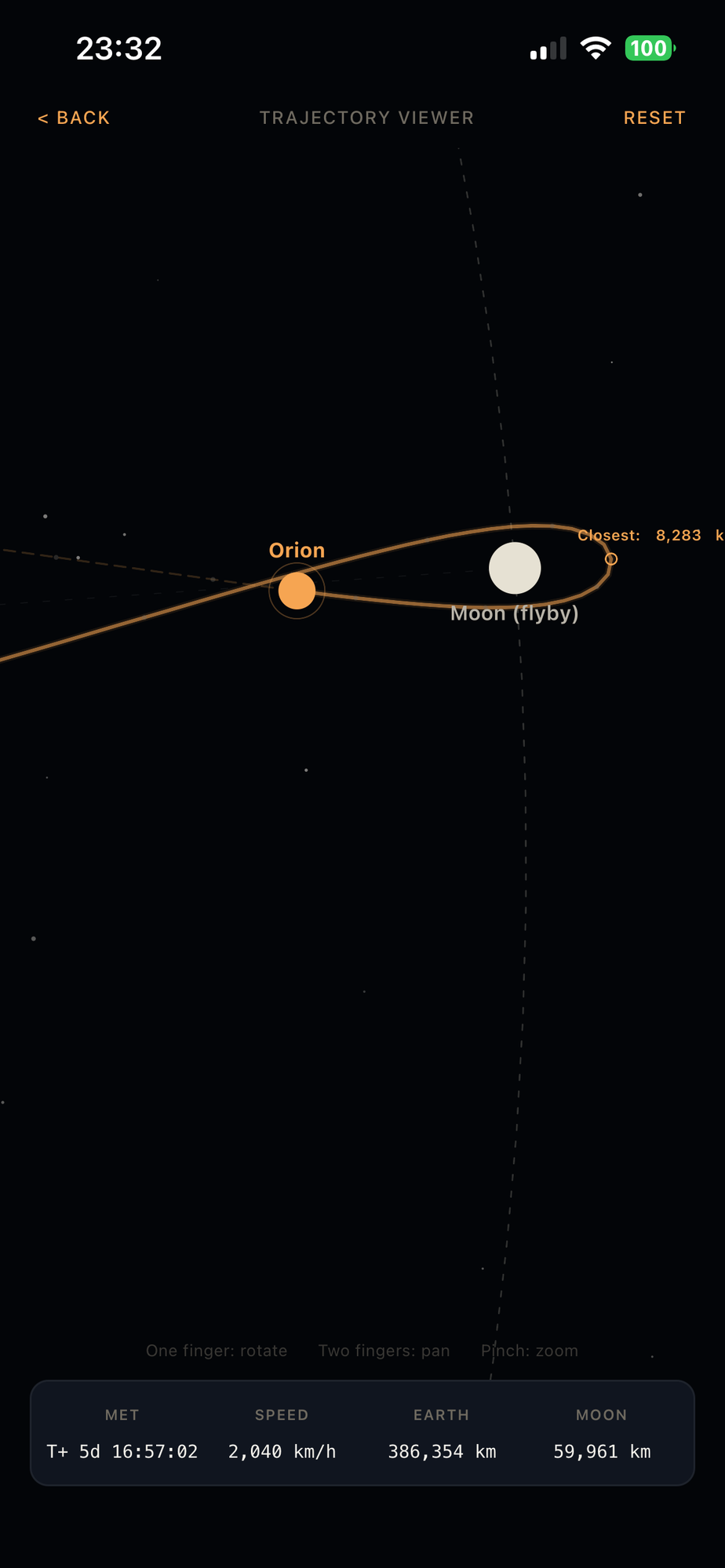
An interactive Earth-Moon scene with Orion's true flight path, rendered from real ephemeris data. Pinch, rotate, scrub time.

Sky Finder AR

Lift your phone and the camera overlay shows you exactly where Orion is overhead - even when it is impossible to see with the naked eye.

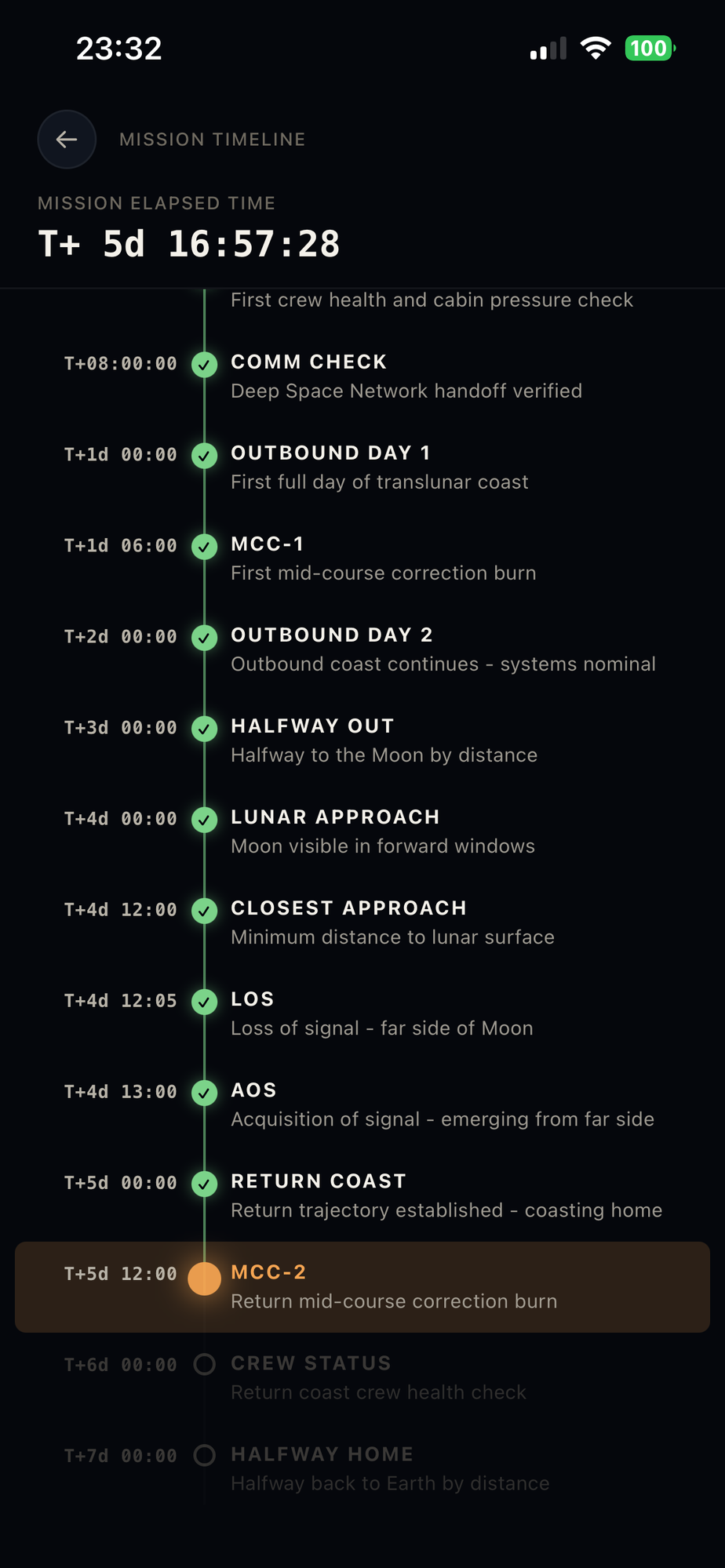
Mission Timeline

SpaceX-style timeline of every major milestone - liftoff, TLI, lunar flyby, return - with countdowns to the next event.

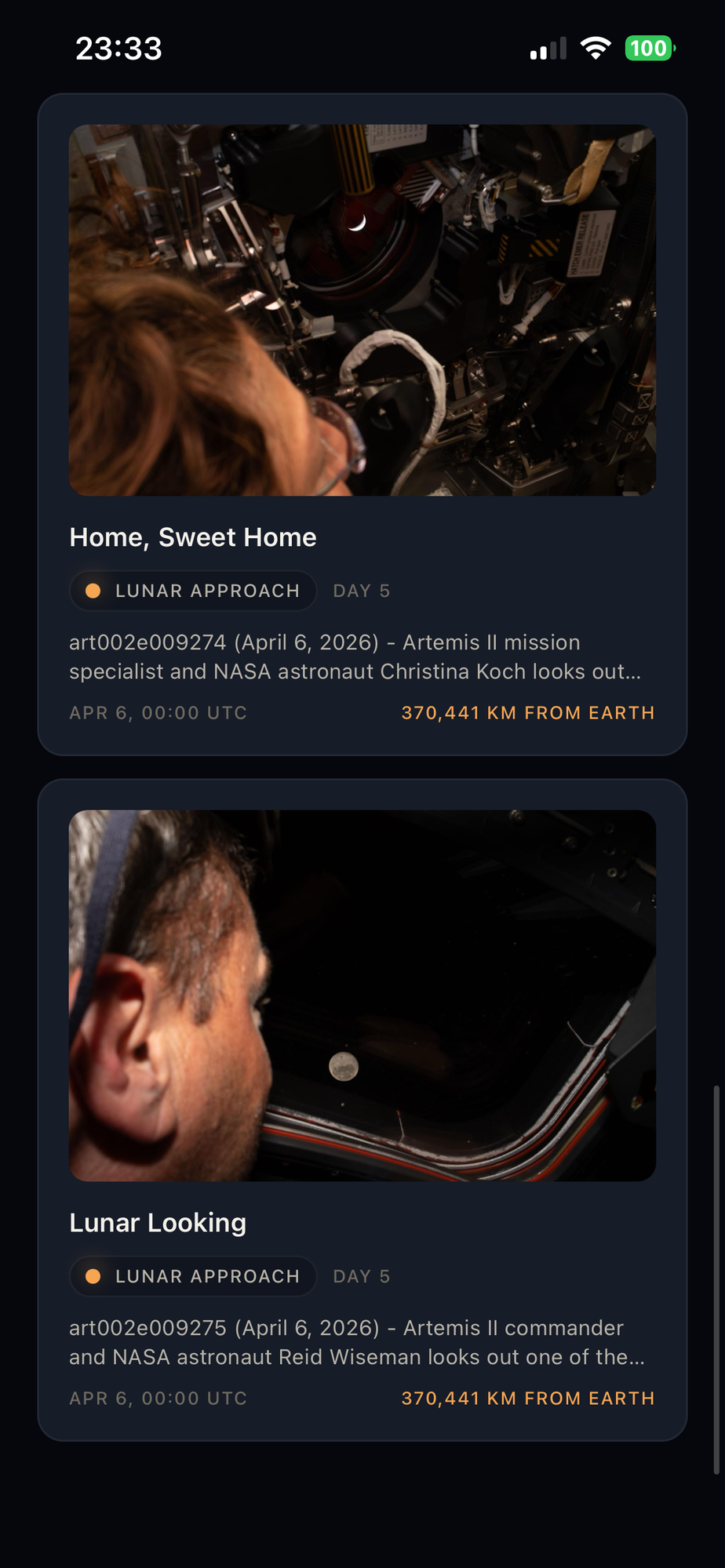
Mission Gallery

NASA imagery mapped to Orion's position when each photo was captured. The visual history of the mission, in context.

Artemis Program Explorer

Dive into every mission of the Artemis program, the spacecraft, the launch vehicles, and the Moon-to-Mars roadmap. Plus a Kid Mode for younger explorers.

Screens

Designed like a flight deck. Built for everyone.

Restrained typography, monospaced telemetry, and a deep-space palette that lets the data breathe.
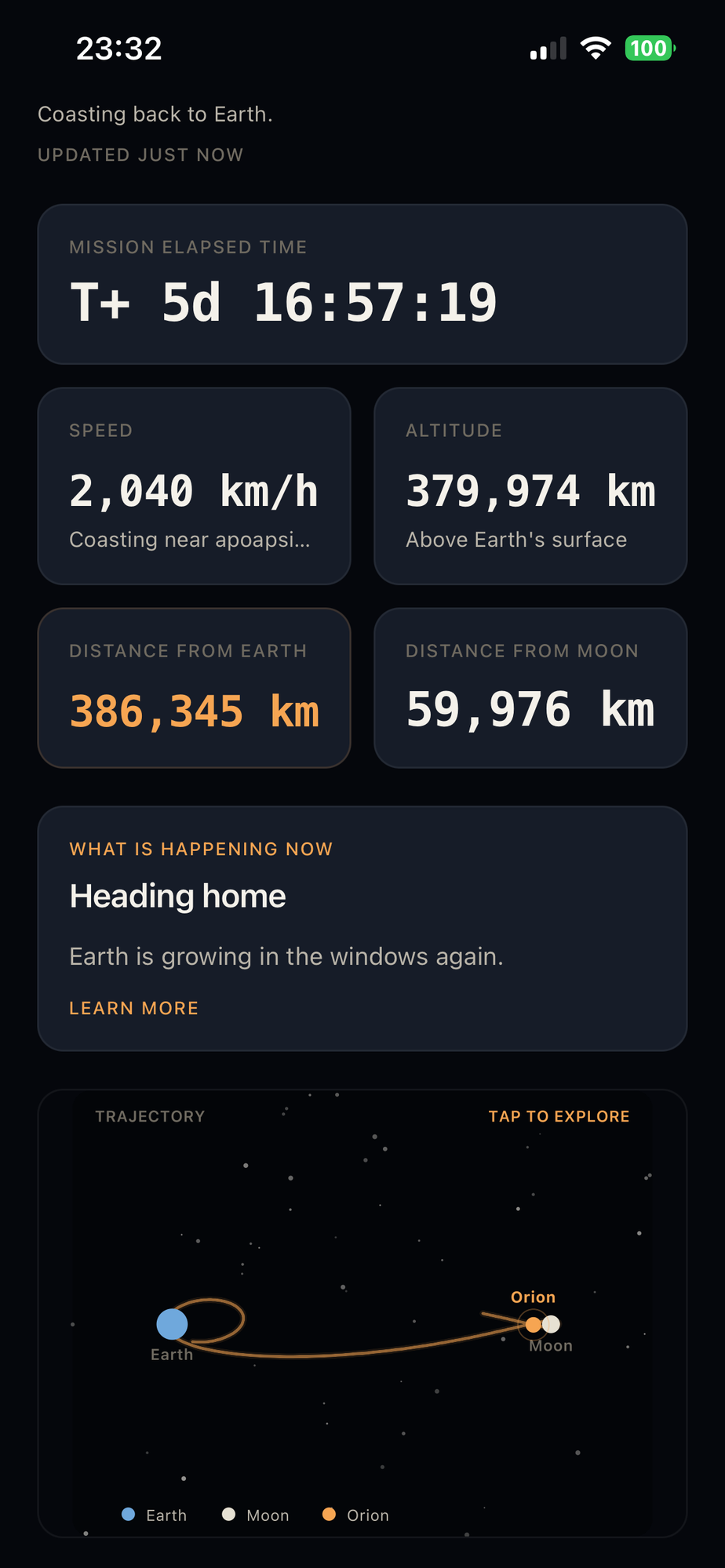
Artemis Lens dashboard with live mission elapsed time, speed, distance from Earth and Moon
Dashboard
Live telemetry from JPL Horizons
3D trajectory viewer showing Orion's free-return flyby around the Moon
Trajectory Viewer
Interactive 3D orbital path
Mission timeline showing every event from liftoff to splashdown
Mission Timeline
Every event, liftoff to splashdown
Mission gallery with real NASA photos from the Artemis II crew
Mission Gallery
Real NASA photos from the crew
About

Built by space fans, for space fans.

Artemis Lens started with a simple question: when humans return to the Moon for the first time in over fifty years, where exactly will they be? Live news streams are great, but we wanted something quieter and more constant - a companion that always knows where Orion is and can show you in a glance.

Every number in the app comes from NASA's Jet Propulsion Laboratory Horizons system, the same source planetariums and mission planners use. Positions, velocities, and distances are interpolated locally on your device so the dashboard stays fluid even when you are offline.

The app is for the family on the couch on launch night, the teacher who wants to bring the mission into their classroom, and the lifelong space fan who wants to know - down to the kilometer - how far Orion has travelled since liftoff. No accounts. No ads. No tracking. Just the mission.

The Mission

Artemis II - the first crewed flight beyond low Earth orbit since 1972.

A free-return trajectory around the far side of the Moon. Four astronauts. About ten days. The dress rehearsal for humanity's return to the lunar surface.

Launch
April 1, 2026
Vehicle
SLS Block 1 / Orion
Profile
Lunar free-return flyby
Duration
~10 days
Commander
Reid Wiseman
Pilot
Victor Glover
Mission Specialist
Christina Koch
Mission Specialist (CSA)
Jeremy Hansen
FAQ

Questions, answered.

Is this an official NASA app?
No. Artemis Lens is an independent companion app and is not affiliated with, endorsed by, or sponsored by NASA or JPL. The authoritative source for the mission remains nasa.gov. We just make their public data easier to enjoy.
Where does the mission data come from?
All trajectory and position data is fetched from NASA's Jet Propulsion Laboratory Horizons system, the same source used by professional planetariums and mission planners. Photos come from the public NASA Images API.
Do I need an internet connection?
Only for the initial sync of the mission ephemeris. After that, the app interpolates positions locally and works fully offline - perfect for stargazing in remote dark-sky sites. New imagery and the latest milestone updates require a connection.
Does Sky Finder need GPS?
For the most accurate sky position, yes - the AR view uses your location and compass to figure out where Orion is overhead. If you decline location access, the app falls back to Kennedy Space Center as a default vantage point. Your location never leaves your device.
Is any of my data collected?
No. Artemis Lens does not collect, store, or transmit any personal data. No accounts, no analytics, no advertising, no cookies. Read the full privacy policy.
When will it launch on the App Store and Google Play?
Soon. The app is in final review and will be available before liftoff on April 1, 2026. Stay tuned at hello@artemislens.app to be notified the moment it goes live.